
// Featured work
Consolidating service catalogs across the Atlassian platform
Coordinating and proposing a new platform app to consolidate service and asset catalog capabilities across Jira Service Management, Assets, Compass, and Atlassian's System of Work.
The situation
Atlassian's customers make a significant investment in cataloging their company's assets. Software development components, IT hardware, licenses, and more need to be modelled and tagged for retrieval.
Atlassian's product silos produced multiple solutions: a services catalog in their ITSM product, a software service catalog in their new development platform Compass, and legacy service/component directories across their flagship product Jira.
Further, Atlassian acquired an asset management product seeking a natural home in the product suite.
Customers were unclear on which app to purchase to suit their needs. In platform and cross-product experiences, they failed to understand which catalog was used to complete tasks.
These duplicative efforts confused customers and stalled adoption.
The goal. Deliver a vision for what a consolidated service catalog could look like.
My role. My role was to lead a design strategy spike, facilitate collaborative sessions, direct execution designers, and contribute to concept development.
The approach
As a member of an experience architecture group, I identified and wrangled stakeholders to contribute designer time from each product silo. I was charged with ensuring experience strategy and architecture across Atlassian's products group complemented executive-level transformations towards an emerging platform and ecosystem model called "system of work."
Working with designers, product managers, and a research partner, we defined customer archetypes and ideal journeys for core catalog use cases in each market. Then, we explored different conceptual models, visualizing core experiences to try to answer questions like: what objects are we solving for (just "software services"), where do these objects live, how are they administered, how do users navigate to them, and how are they viewed?
The toolkit:
- Design gameplan
- Stakeholder mapping
- Secondary research
- Project kickoff
- Current product walkthrough
- Customer archetypes
- Conceptual mapping
- Journey mapping
- Entity/relationship diagramming
- Concept development
- Concept testing
- Recommendation and report writing
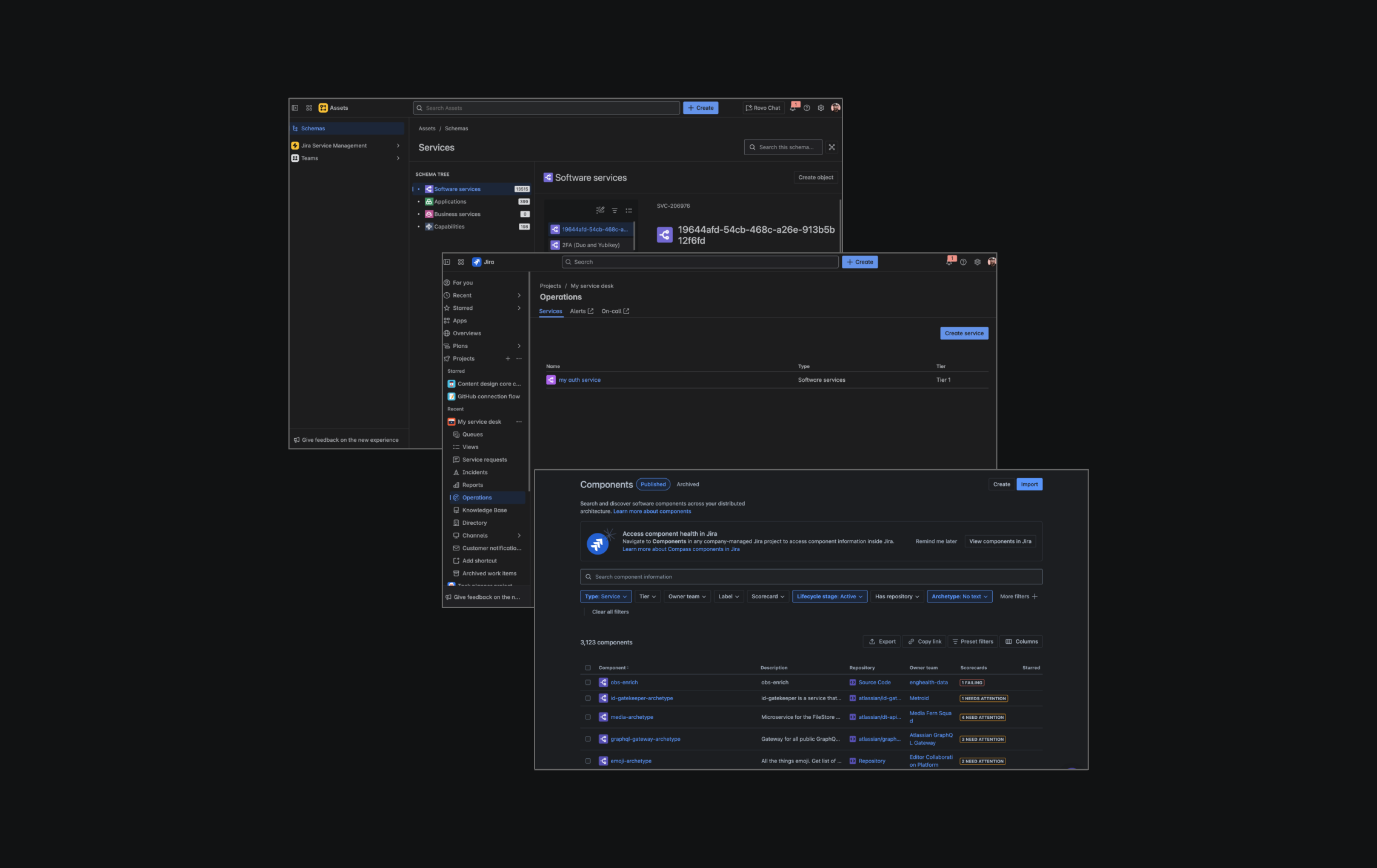
Current product walkthroughs helped the core team get across each conceptual domain. At the same time, they allowed stakeholders to provide context, nuance, and requirements. They broke the ice for the collaborative sessions to follow.
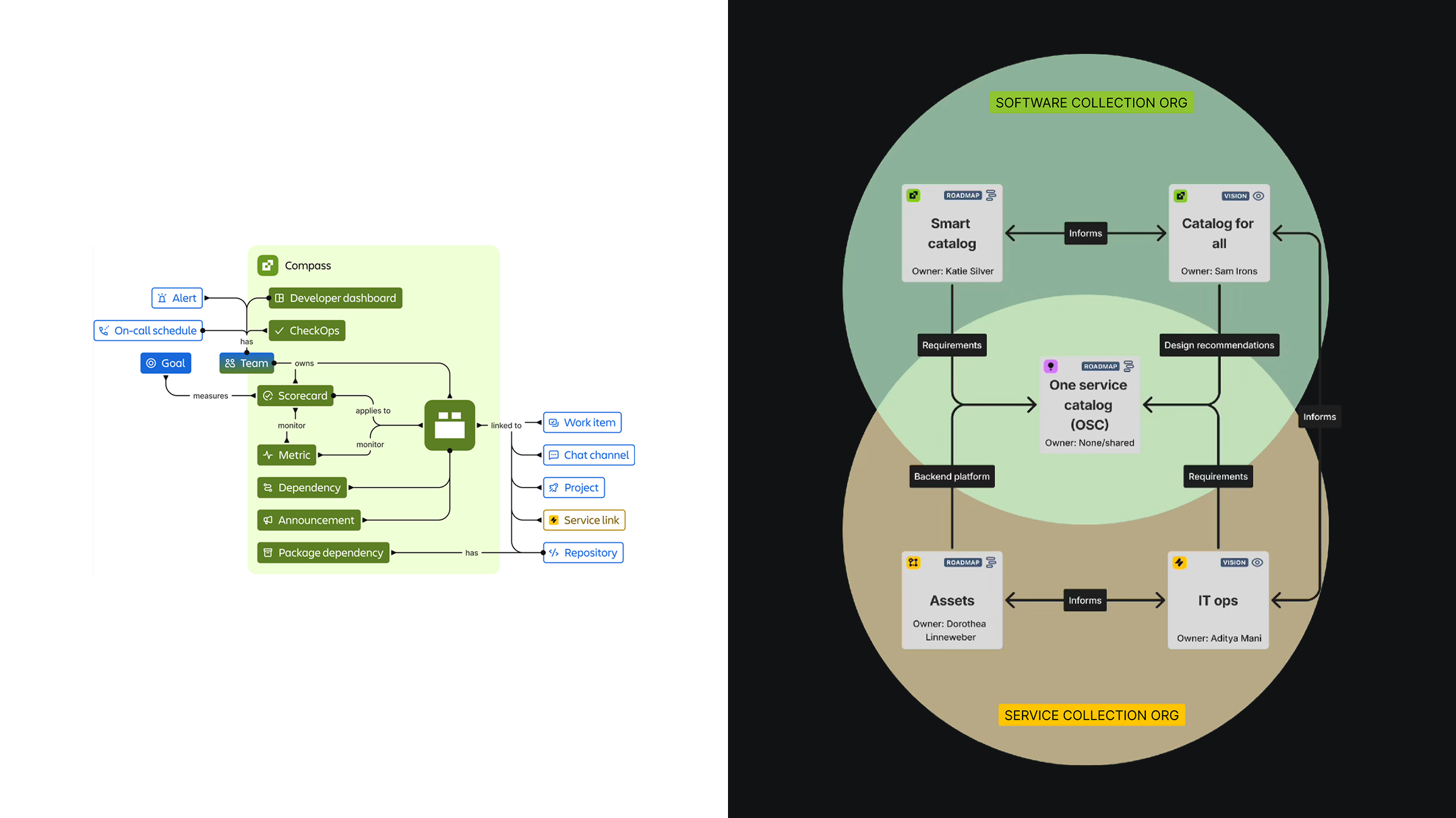
Visual communication was crucial to distributed teams with work in flight. With so much overlap, and roadmap work waiting for recommendations, I worked to clarify how teams should interpret their streams of work. Not blocking, checking for one-way doors.
The outcome
“More context means we're more opinionated.”
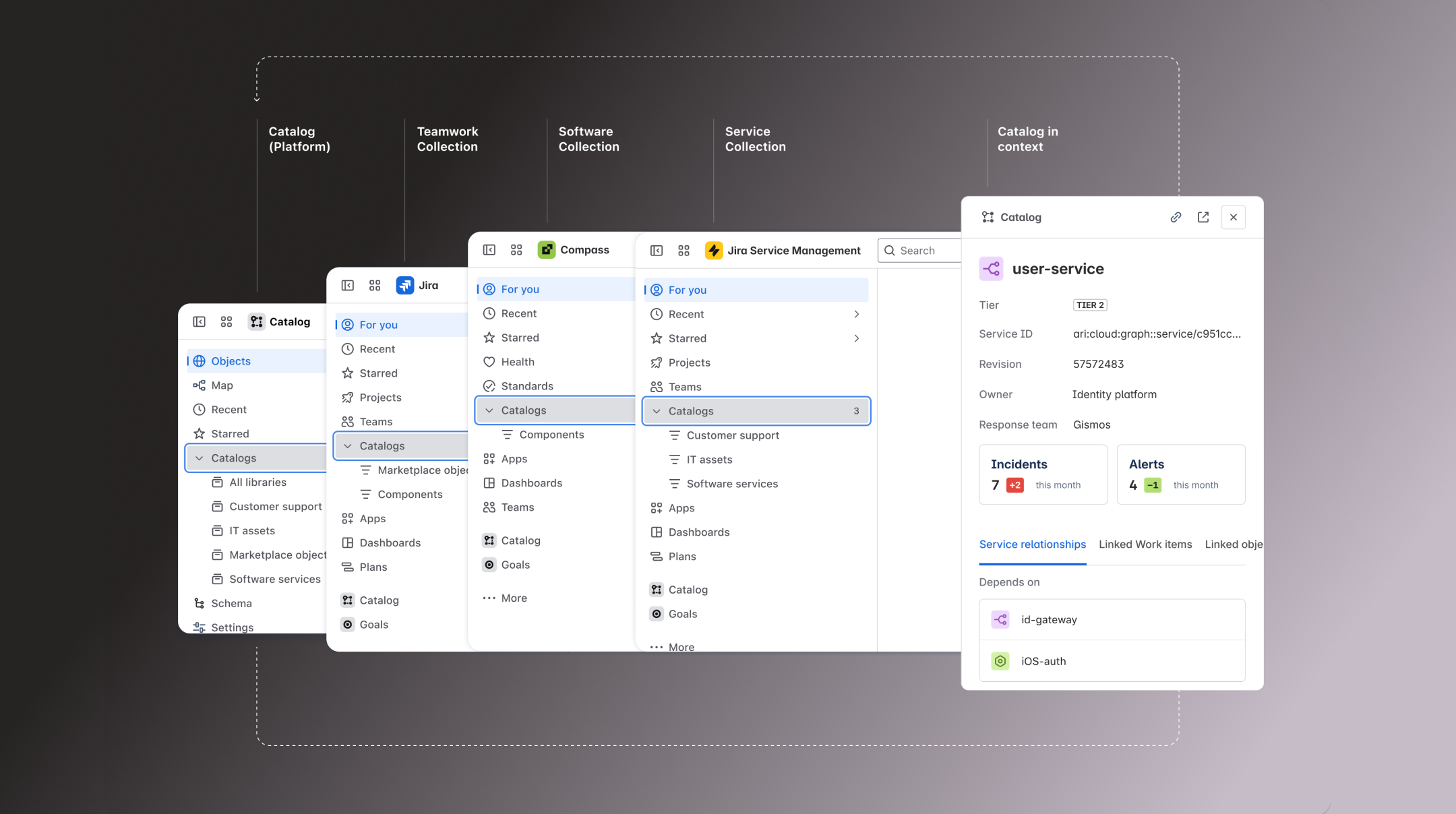
We envisioned a platform catalog app that houses master object records, accompanied by filtered object directories available as top-level app entries and contextual object details views tailored to the jobs they inform. Our mantra is above.
The platform catalog supports catalog jobs, like managing component objects and understanding rollup metrics about object health. Objects viewed here show all their metadata.
Object directories in federated apps filter the catalog to a subset of objects relevant to their app context.
And, contextual object detail panels prioritize metadata associated with the user jobs on the screen where they appear.
This vision:
- Influenced leadership to reorganize engineering teams, giving Assets a home in the platform org.
- Influenced the design of the consolidated backend database.
- Contributed new directory patterns to the Atlassian Design System.
- Salvaged Compass work from an otherwise unsuccessful attempt to find product market fit.
- Freed up several engineering teams to focus on other high-priority work.
- Educated and up-leveled local product leadership on Atlassian's emerging "system of work" thinking.
The learnings
The biggest challenge in this project was navigating org silos and competing roadmaps across multiple products serving multiple markets.
The power of simple, clear diagramming cut through politics, clarified the opportunities for each business unit. By visualizing the overlap and duplication above and across business units, I was able to drive better alignment between leadership teams.
I leveraged relationships with lead designers and product managers in each space to help translate our communications to different leadership audiences.
Getting everyone to speak the same language helped clarify how each silo can contribute to a greater company vision.
This work also pushed me to present and defend this vision at the C-Suite level, including presenting in front of the CEO, President, and Chief Design Officer. I learned a lot about what execs are looking for, how to present the right elevation, and how to push for organizational change to achieve design visions.
On a personal note, I was pleased to help a lead designer expand their role and remit into a platform role as an outcome of this work. And, I was happy to help a newly-acquired product find their fit within the Atlassian ecosystem.